


Blue Sphere — Integrated Full-Stack Blueprint
Version: v04
Status: Integrated working blueprint (engineering + governance + economics)
What This Is
Blue Sphere consolidates the existing North Atlantic infrastructure concept and adds the missing full-stack layers:
- Data centers + edge compute + latency strategy
- Cold-environment operations (pros/cons), including HVAC/cooling economics
- Workforce/HR + remote facilities requirements
- Expanded connectivity stack: satellite (incl. Starlink), 3GPP NTN, LoRa/Meshtastic, VDES/AIS, HF, emergency comms
- Quantum-era security + cryptographic upgrade path
- Settlement/town-building + governance models
Core Assumptions
- Dual-use undersea backbone — fiber + sensing that carries commercial traffic while adding DAS/DTS-style undersea awareness
- Arctic / North Atlantic constraints are binding — weather, logistics, ice, repair windows, sovereignty/Indigenous consultation
- Compute growth is a structural driver — IEA projects global data center electricity demand rising from ~415 TWh (2024) to ~945 TWh by 2030 (roughly 2.3×)
- Quantum computing is a timeline risk — design for “harvest now, decrypt later” and future migration to standardized post-quantum crypto
Binding Constraints
Engineering
- Undersea cable routing/burial feasibility, repeaters, fault isolation, and repair logistics
- Sensor data volume vs edge processing (you cannot ship everything raw)
- Power delivery for hubs, edge sites, and potential HVDC concepts
Logistics & Operations
- Ice/weather limits on maintenance windows
- Secure supply chain for optical components, repeaters, crypto modules
Governance
- Ownership/landlord structure at landing points (Greenland in particular)
- Regulatory approvals (environmental, telecom, security) across Canada/Greenland/Denmark/Iceland/US
Economics
- Who pays capex and why (commercial traffic + “defense premium” + climate science + resilience)
- Local operating costs dominated by staffing, spares, transport, and energy
Document Map
| Artifact | Purpose |
|---|---|
| Master Blueprint (this series) | Systems integration layer |
| Registers (XLSX) | Requirements, risks, stakeholders, phasing, tests |
| Technology Register (CSV) | Expanded “full stack” tech inventory |
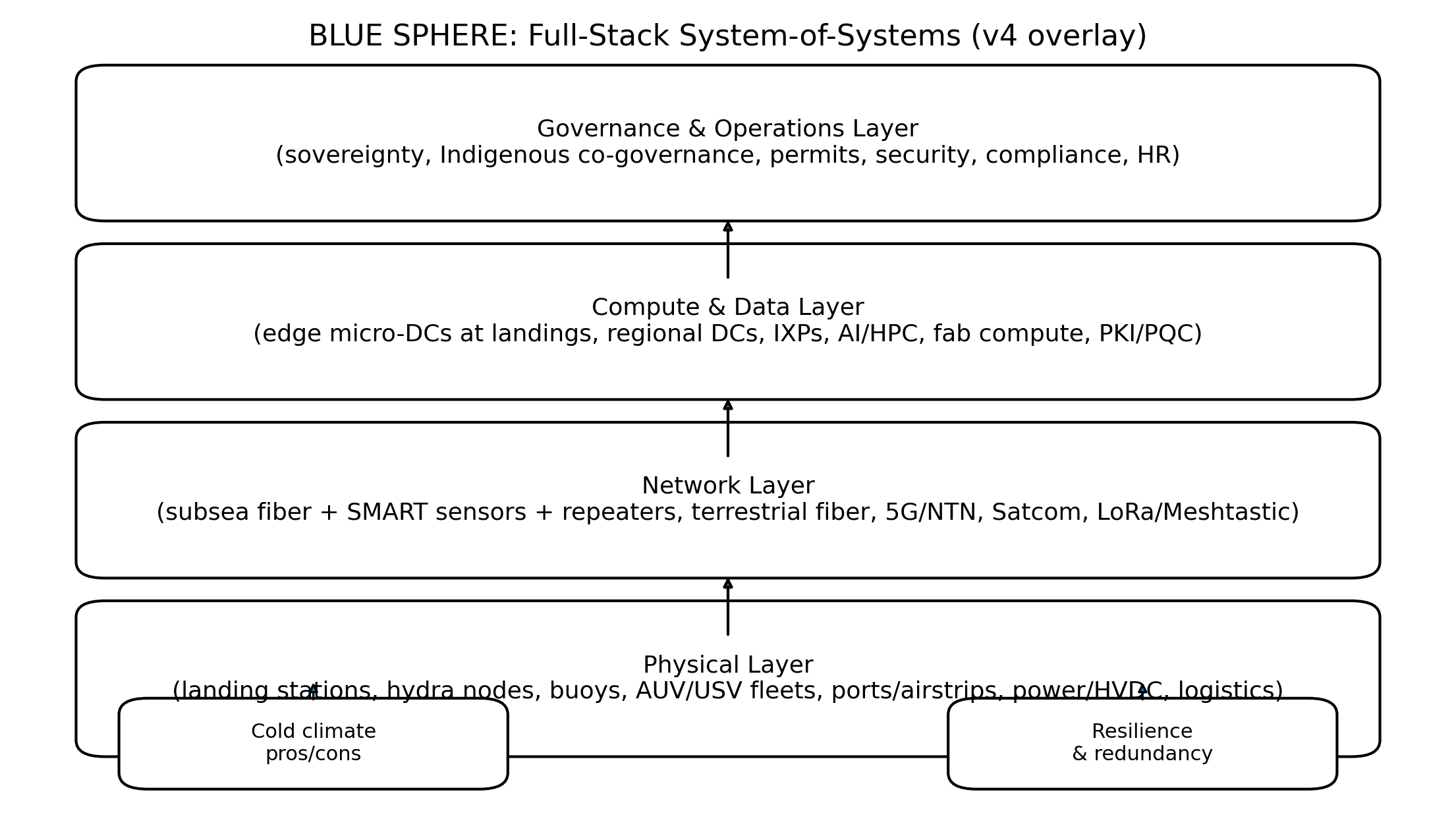
| Architecture Diagram | System-of-systems visual |
| Charts | Datacenter demand, latency floor, PUE overhead, CAPEX phases |
Next: The Layers
This blueprint is organized into eight architectural layers:
- Physical Layer — SMART-core subsea backbone
- Sensing Layer — Ocean + seabed intelligence
- Communications Layer — Last-mile and failsafes
- Compute Layer — Edge → regional → sovereign cloud
- Power + Thermal — Why cold matters
- Security Layer — Undersea + cyber + quantum-era
- People Layer — HR, facilities, settlements
- Governance — Landlord model + risk-sharing