


Physical Layer: SMART-Core Subsea Backbone
The physical layer forms the foundation of Blue Sphere — undersea fiber trunk routes designed for both commercial traffic and integrated sensing.
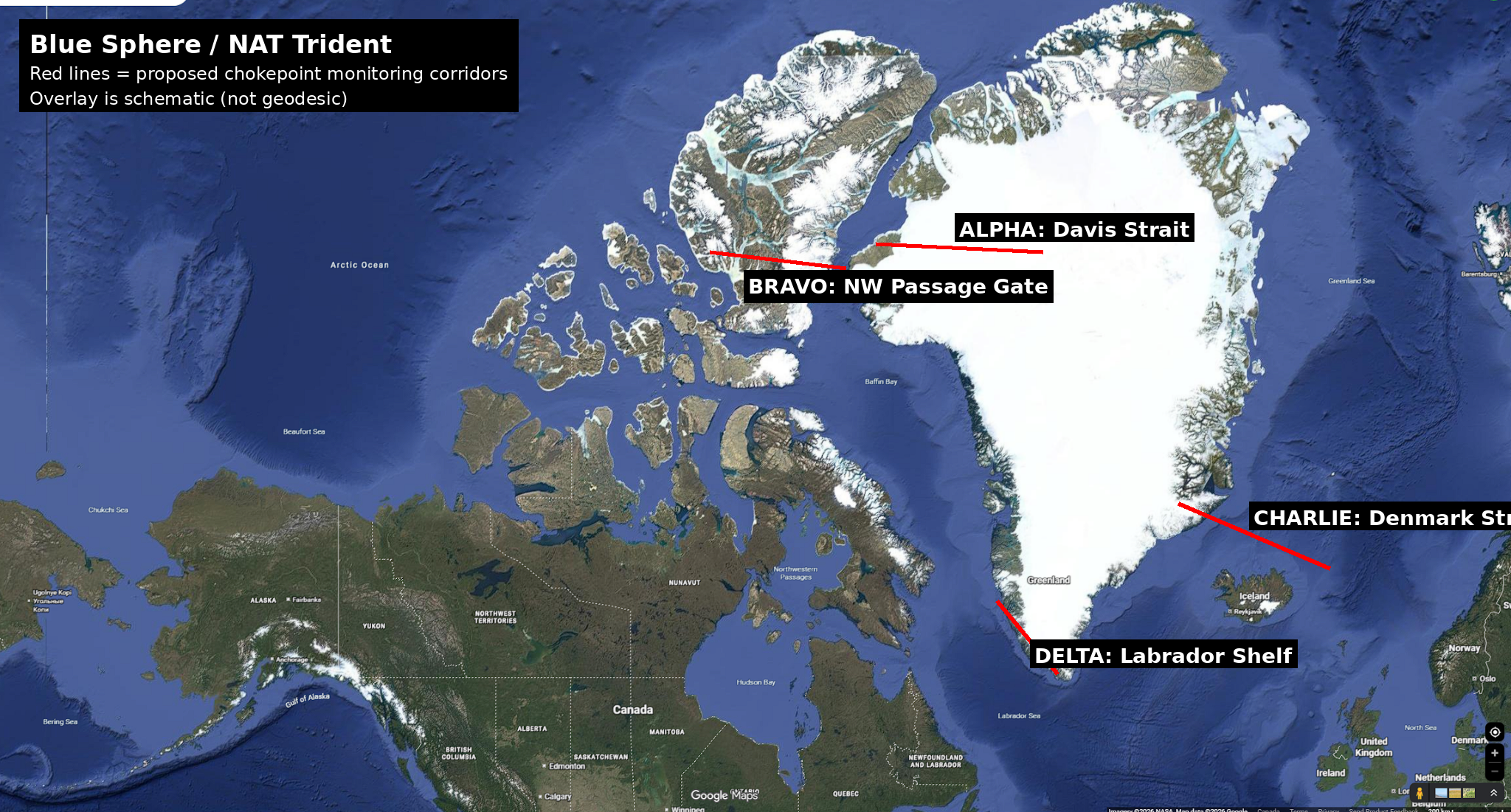
Baseline Trunk Routes
From the v3 blueprint:
- Alpha — Davis Strait corridor
- Bravo — Lancaster Sound corridor
- Charlie — Denmark Strait corridor
- Delta — Labrador shelf spurs
Multi-Core Cable Design
Each cable segment integrates:
| Component | Purpose |
|---|---|
| Telecom fiber pairs | Commercial and government traffic |
| DAS/DTS sensing fibers | Distributed acoustic/temperature sensing |
| Power conductors | Where feasible, for subsea equipment |
Cable Security & Resilience
Design practices align with emerging policy direction (EU submarine cable recommendations):
- Mapping — Complete route survey and burial feasibility
- Risk assessment — Fault isolation planning
- Stress testing — Repair capacity validation
- Coordination mechanisms — Multi-stakeholder response protocols
Repair Realism
Arctic conditions demand realistic repair planning:
- Pre-positioned spares at strategic locations
- Repair kits sized for common failure modes
- Vessel access planning with winter constraint windows
- Cable burial depth optimized for ice scour zones
Design principle: If you can’t repair it in winter, it will fail in winter.
Key References
- EU Commission Recommendation 2024/779 (Submarine Cables)
- SMART cables concept (Science Monitoring and Reliable Telecommunications)